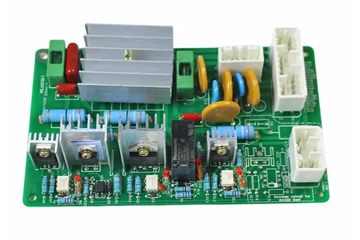
Optical Control Circuit Implementation in PCB Assembly for Projectors
The optical control circuit is a cornerstone of projector PCB assembly, managing light source modulation, color accuracy, and image alignment to deliver high-quality projections. This circuit integrates sensors, drivers, and microcontrollers to synchronize optical components with display data. Below are key considerations for designing and implementing optical control circuits in projector PCBs.
1. Light Source Modulation and Driver Circuitry Projectors rely on precise control of light sources, whether LEDs, lasers, or traditional lamps, to adjust brightness and color temperature dynamically. For LED-based systems, the driver circuit must supply stable currents to red, green, and blue (RGB) channels while compensating for thermal drift. Pulse-width modulation (PWM) dimming is commonly used to achieve smooth brightness transitions without color shifts. The PCB should include high-efficiency buck converters to step down voltages efficiently, reducing heat generation in compact form factors.
Laser projectors demand even tighter control over output power and wavelength stability. The driver circuit must incorporate feedback loops using photodiodes to monitor laser intensity, adjusting drive currents in real time to counteract aging or environmental changes. High-speed comparators on the PCB compare sensor readings with reference values, triggering corrections via MOSFETs or dedicated laser driver ICs. EMI filtering components, such as ferrite beads and bypass capacitors, suppress noise from switching circuits to prevent interference with optical signals.
2. Color Management and Gamma Correction Achieving accurate color reproduction requires calibrating the intensity of each RGB channel based on input signals. The optical control circuit includes digital-to-analog converters (DACs) to translate pixel data from the projector’s processor into analog voltages for the light source drivers. Lookup tables (LUTs) stored in onboard memory map input color values to corrected outputs, compensating for nonlinearities in the display pipeline. The PCB must allocate sufficient memory bandwidth to handle high-resolution content without latency.
Gamma correction adjusts the brightness-to-voltage relationship to match human visual perception, ensuring smooth gradients in dark scenes. This process involves real-time calculations by a microcontroller or dedicated gamma correction IC on the PCB. To minimize power consumption, some designs offload gamma processing to the projector’s main SoC, communicating corrected values via high-speed interfaces like I2C or SPI. The PCB layout should prioritize short, shielded traces for gamma-related signals to avoid crosstalk with noisy components like power supplies.
3. Dynamic Focus and Lens Shift Control Modern projectors incorporate motorized lenses for automatic focus adjustment and horizontal/vertical keystone correction. The optical control circuit drives stepper motors or voice coil actuators to reposition lens elements based on sensor feedback. Microstepping drivers on the PCB enable precise movement control, reducing audible noise during adjustments. Closed-loop systems use Hall effect sensors or optical encoders to verify lens positions, feeding data back to the microcontroller for error correction.
Lens shift functionality requires synchronizing multiple motors to maintain image geometry while moving the optical axis. The PCB must include motor driver ICs capable of handling the combined current draw of all actuators, with thermal shutdown protection to prevent overheating. Decoupling capacitors near motor drivers stabilize power supplies during sudden current spikes, while snubber circuits suppress voltage transients generated by inductive loads. Firmware algorithms optimize motor sequences to minimize adjustment time without sacrificing accuracy.
4. Ambient Light Sensing and Adaptive Brightness To enhance visibility in varying lighting conditions, projectors integrate ambient light sensors that detect room brightness levels. The optical control circuit processes sensor outputs to adjust projector brightness and contrast dynamically. Analog front-end circuits on the PCB amplify weak sensor signals and filter out 50/60 Hz flicker from artificial lighting. A microcontroller compares ambient readings with predefined thresholds, triggering incremental changes to light source output or display settings.
Some advanced designs use RGB ambient sensors to analyze light color composition, enabling more nuanced adjustments. For example, the circuit might increase red channel intensity under warm incandescent lighting to maintain color balance. The PCB should position sensors away from heat sources like lamps or power regulators to avoid skewed readings. Additionally, a transparent optical window in the projector’s casing ensures consistent light exposure to the sensors without obstructing airflow for cooling.
5. Thermal Management for Optical Components High-intensity light sources generate significant heat, which can degrade optical performance or damage components if not managed properly. The optical control circuit includes temperature sensors placed near the light engine, color wheel, or DMD chip (in DLP projectors) to monitor thermal conditions. Thermistors or digital temperature sensors feed data to the microcontroller, which activates cooling fans or adjusts light output to prevent overheating.
The PCB layout must account for airflow patterns within the projector chassis, routing traces away from hot spots and using thermal vias to transfer heat to copper pours or heatsinks. For laser projectors, active cooling systems like Peltier modules may be required to maintain precise wavelength stability. The optical control circuit regulates Peltier current based on sensor feedback, balancing cooling efficiency with power consumption. Conformal coating on the PCB protects against dust or humidity, which could insulate components and exacerbate thermal issues.
Conclusion Implementing optical control circuits in projector PCB assembly demands careful integration of light source drivers, color calibration systems, and motor control mechanisms. By optimizing signal integrity, thermal management, and adaptive features, manufacturers can create projectors that deliver consistent image quality across diverse environments. Rigorous testing during PCB assembly ensures compatibility with optical components and identifies potential issues like crosstalk or thermal hotspots early in the development cycle.