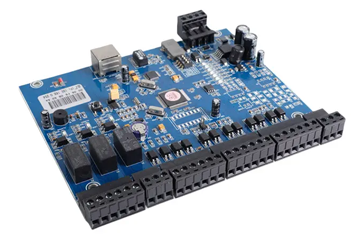
Anti-Fraud Design Considerations for PCB Assembly in Financial Equipment
Financial devices, such as ATMs, point-of-sale (POS) terminals, and card readers, are prime targets for fraudulent activities due to their handling of sensitive transactions and user data. PCB assemblies in these systems must incorporate robust anti-fraud measures to prevent tampering, data theft, and unauthorized access. Below are critical design strategies and implementation techniques to enhance security in financial equipment PCBs.
1. Tamper-Evident Enclosures and Physical Security Layers Protecting PCBs from physical manipulation is the first line of defense against fraud. Tamper-evident enclosures use materials that visibly deform or break when accessed, alerting technicians to potential intrusion attempts. These enclosures often integrate conductive traces or mesh layers on the PCB surface, creating open circuits when dismantled. Any disruption triggers alarms or erases sensitive data stored in secure memory chips.
Additionally, conformal coatings shield PCBs from environmental damage while making it difficult for attackers to probe components without leaving traces. Epoxy resins or silicone-based coatings obscure solder joints and traces, complicating efforts to attach external devices for signal interception. Some designs incorporate embedded fiber-optic strands within the enclosure, which fracture upon forced entry, providing irrefutable evidence of tampering.
2. Secure Boot and Firmware Authentication Mechanisms Financial devices rely on trusted firmware to execute transactions securely. Secure boot processes verify the integrity of firmware during startup by checking digital signatures against a preloaded root of trust. If tampering is detected, the system locks down or initiates a self-destruct sequence for cryptographic keys. This prevents attackers from injecting malicious code to manipulate transaction data or steal credentials.
Firmware authentication extends beyond boot-time checks. Regular over-the-air (OTA) updates must use cryptographic protocols like AES-256 or RSA-2048 to ensure patches originate from authorized sources. Hardware security modules (HSMs) on the PCB can store root keys separately from the main processor, isolating critical cryptographic operations from potential software exploits.
3. Cryptographic Hardware Acceleration and Key Management Financial transactions require strong encryption to protect data in transit and at rest. PCB designs integrate dedicated cryptographic accelerators to handle operations like AES, SHA, and RSA efficiently without overburdening the main CPU. These accelerators reduce latency during peak usage while minimizing power consumption, which is crucial for battery-powered devices like mobile POS terminals.
Effective key management is equally vital. Secure elements or trusted platform modules (TPMs) on the PCB generate, store, and manage encryption keys in isolation from other system components. Physical separation prevents attackers from extracting keys through software vulnerabilities. Some designs use one-time programmable (OTP) memory to bind keys to specific hardware instances, ensuring they cannot be transferred to cloned devices.
4. Side-Channel Attack Mitigation Techniques Side-channel attacks exploit unintended emissions (e.g., electromagnetic, power, or acoustic) to infer cryptographic keys or sensitive data. Financial equipment PCBs must mitigate these risks through careful layout and shielding. Differential power analysis (DPA)-resistant circuits balance power consumption across operations to prevent attackers from correlating fluctuations with key bits.
Electromagnetic shielding involves enclosing sensitive components, such as cryptographic processors, in Faraday cages or using grounded copper layers in the PCB stack-up. Noise injection techniques add random fluctuations to power or timing signals, obscuring patterns that attackers might analyze. Additionally, algorithmic countermeasures like constant-time implementations ensure cryptographic operations take uniform duration, regardless of input values.
5. Real-Time Anomaly Detection and Secure Logging Continuous monitoring of system behavior helps identify fraud attempts in progress. PCBs can integrate microcontrollers dedicated to anomaly detection, analyzing metrics like transaction frequency, power consumption, or communication patterns. Deviations from baseline profiles trigger alerts or initiate secure shutdown procedures.
Secure logging ensures all detected anomalies are recorded without tampering. Tamper-resistant memory chips store logs in a write-once format, preventing attackers from erasing or modifying records. Time-stamping logs with secure clocks (e.g., those synchronized via GPS or NTP) provides an audit trail for forensic analysis. These logs can be encrypted and transmitted to remote servers for centralized monitoring, enabling rapid response to emerging threats.
Conclusion Anti-fraud design in financial equipment PCBs demands a multi-layered approach combining physical security, cryptographic robustness, and real-time monitoring. By integrating tamper-evident features, secure boot mechanisms, cryptographic hardware, side-channel resistance, and anomaly detection, manufacturers can create systems resilient to evolving fraud tactics. Each strategy addresses specific attack vectors, ensuring comprehensive protection for transactions and user data in an increasingly connected financial landscape.