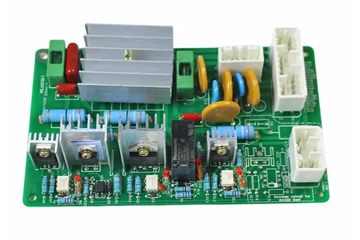
In PCB manufacturing, the selection of surface treatment processes directly affects the reliability, cost and applicable scenarios of the products. The following is a comparative analysis of common surface treatment processes, covering mainstream technologies such as hot air leveling (HASL), organic solder mask (OSP), electroless nickel plating and gold Immersion (ENIG), Immersion Silver, and Immersion Tin:
Hot Air Leveling (HASL)
Principle: Immerse the PCB in molten solder, and use a hot air knife to smooth out the excess solder to form a flat tin-lead or lead-free solder layer.
Advantages:
Low cost, mature technology, suitable for large-scale production.
It has excellent welding performance and is suitable for both manual welding and wave soldering.
Disadvantage:
The surface flatness is poor and it is not suitable for fine-pitch components (such as BGA, QFN).
Lead may remain in the solder (traditional HASL), which does not meet the RoHS environmental protection requirements (lead-free HASL has solved this problem).
High-temperature treatment may cause PCB deformation.
Application scenarios: General electronic products, cost-sensitive projects.
2. Organic Solder Mask (OSP)
Principle: A layer of organic compound film is formed on the surface of copper to prevent oxidation. During welding, the flux can remove this film.
Advantages:
Environmentally friendly and lead-free, it complies with RoHS requirements.
Low cost, simple process, suitable for high-frequency signal transmission (smooth surface).
Disadvantage:
It has poor corrosion resistance and a short storage period (usually 3 to 6 months), and requires sealed packaging.
The performance declines after multiple reflow soldering processes, making it unsuitable for complex soldering procedures.
Application scenarios: consumer electronics, short-term storage products, high-frequency circuits.
3. Electroless Nickel plating and gold immersion (ENIG
Principle: First, electroless nickel plating (5-6μm) is carried out, followed by gold immersion (0.05-0.1μm) to form a nickel-gold composite layer.
Advantages:
The surface is smooth and flat, suitable for fine-pitch components (such as BGA, CSP).
It has strong corrosion resistance and a long storage period (more than one year).
It has excellent welding performance and can be reflow soldered multiple times.
Disadvantage:
The cost is high, the process is complex, and the thickness of the nickel layer needs to be strictly controlled.
There may be a "black disk" problem (poor welding due to oxidation of the nickel layer).
Application scenarios: high-end electronic products, communication equipment, automotive electronics.
4. Immersion Silver
Principle: A layer of pure silver (0.1-0.3μm) is deposited on the surface of copper through a displacement reaction.
Advantages:
The cost is moderate and the process is simple.
Good electrical conductivity, suitable for high-frequency circuits.
The surface is smooth and the welding performance is good.
Disadvantage:
Silver is prone to sulfidation and may discolor after long-term storage, affecting its welding performance.
It has poor corrosion resistance and is not suitable for harsh environments.
Application scenarios: consumer electronics, communication equipment, short-term storage products.
5. Immersion Tin
Principle: A layer of pure tin (0.8-1.2μm) is deposited on the surface of copper through a displacement reaction.
Advantages:
Low cost and simple process.
The surface is smooth and flat, suitable for fine-pitch components.
Lead-free and environmentally friendly, in compliance with RoHS requirements.
Disadvantage:
It is prone to produce "tin whiskers", which may cause short circuits.
It has poor corrosion resistance and a short storage period (within 6 months).
Application scenarios: Mid-to-low-end electronic products, cost-sensitive projects.
Selection suggestions
Low-cost, universal products: HASL or tin plating is preferred.
High-frequency signals and fine-pitch components: Choose ENIG or OSP.
High-end, long-term storage products: Choose ENIG.
For short-term storage and high-frequency circuits: Choose silver plating or OSP.
According to specific requirements (such as cost, reliability, environmental protection requirements, etc.), different surface treatment processes can be flexibly selected or combined for use.


