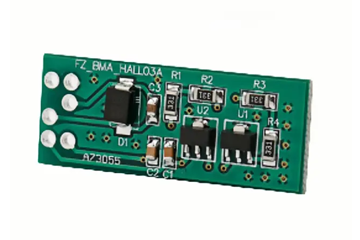
Data Acquisition and Transmission in Smart Sensor PCB Assembly Smart sensor PCBs form the backbone of IoT ecosystems by enabling precise environmental monitoring and seamless data transfer to cloud platforms or edge devices. These circuits integrate analog-to-digital conversion, wireless communication, and power management to handle diverse sensor inputs while maintaining reliability in dynamic conditions. Below, we explore the technical implementation of data acquisition and transmission in smart sensor PCBs.
1. High-Precision Analog-to-Digital Conversion for Sensor Interfaces
Multi-Channel ADC Configurations for Diverse Sensor Types Smart sensor PCBs support simultaneous sampling of multiple analog inputs, such as temperature, humidity, pressure, or light intensity, using multi-channel analog-to-digital converters (ADCs). Delta-sigma ADCs are commonly employed for low-frequency signals (e.g., thermocouple readings) due to their high resolution and noise rejection capabilities. Successive-approximation register (SAR) ADCs, on the other hand, excel in high-speed applications (e.g., vibration analysis) by converting signals in microseconds. The PCB routes sensor outputs through low-pass filters to eliminate high-frequency noise before ADC conversion, ensuring accurate digital representations of physical phenomena.
Programmable Gain Amplification for Dynamic Range Adjustment To accommodate sensors with varying output voltages, the PCB incorporates programmable gain amplifiers (PGAs) that adjust signal amplification dynamically. For instance, a photodiode generating millivolt-level signals may require a gain of 100x, while a strain gauge producing volts needs minimal amplification. The MCU on the PCB configures PGA settings via digital interfaces like I2C or SPI, optimizing signal-to-noise ratio (SNR) for each sensor channel. Some designs include auto-ranging features that analyze input voltage levels and select the appropriate gain automatically, reducing calibration complexity.
Calibration and Compensation for Sensor Nonlinearities Environmental factors like temperature drift or aging can alter sensor characteristics over time. The PCB addresses this by storing calibration coefficients in non-volatile memory (e.g., EEPROM or flash) during manufacturing. During operation, the MCU applies these coefficients to raw ADC readings using polynomial or piecewise linear correction algorithms. For example, a thermistor’s resistance-temperature curve may be compensated using a Steinhart-Hart equation to convert ADC counts into accurate Celsius values. Some PCBs support in-field recalibration via reference signals from external standards or cloud-based correction tables updated through firmware patches.
2. Low-Power Wireless Communication Protocols for Data Transmission
LPWAN Technologies for Long-Range, Battery-Optimized Networks Smart sensor PCBs often leverage Low-Power Wide-Area Networks (LPWANs) like LoRaWAN or NB-IoT to transmit data over kilometers while consuming minimal energy. LoRa’s chirp spread spectrum modulation enables sub-100mA peak currents during transmission, extending battery life to years for devices reporting once per hour. The PCB integrates a LoRa transceiver with a power amplifier (PA) and low-noise amplifier (LNA) to boost signal range without exceeding regulatory emission limits. For licensed-spectrum applications, NB-IoT modules use existing cellular infrastructure to provide reliable coverage in urban environments, prioritizing low data rates (e.g., 20–50 kbps) for sensor telemetry.
Bluetooth Low Energy (BLE) for Short-Range, High-Throughput Streaming When proximity to a gateway or smartphone is guaranteed, BLE offers a cost-effective alternative with faster data rates (up to 2 Mbps) and lower latency than LPWANs. The PCB employs BLE 5.0 or later versions to support extended advertising and higher payload sizes, enabling bulk transfers of buffered sensor data. Connectionless modes like BLE broadcasting allow sensors to periodically transmit data without establishing a dedicated link, reducing power consumption. Some designs combine BLE with mesh networking protocols (e.g., Bluetooth Mesh) to create self-healing networks where sensors relay packets, extending coverage in large facilities like warehouses or factories.
Dual-Mode Radios for Flexible Connectivity Options To future-proof deployments, certain PCBs integrate dual-mode radios capable of switching between Wi-Fi and BLE based on availability. Wi-Fi provides high-speed internet access for real-time streaming of high-resolution sensor data (e.g., video feeds from camera-equipped sensors), while BLE acts as a fallback for local control or configuration. The MCU manages network handovers using criteria like signal strength, data volume, and power constraints. For example, a PCB may use Wi-Fi for initial setup and firmware updates, then revert to BLE during normal operation to conserve battery. Security protocols like WPA3 (for Wi-Fi) and LE Secure Connections (for BLE) encrypt data in transit, preventing eavesdropping.
3. Edge Computing and Data Preprocessing for Efficient Transmission
On-Device Filtering and Anomaly Detection Smart sensor PCBs reduce cloud dependency by processing data locally before transmission. Digital filters (e.g., moving average or Kalman filters) smooth noisy readings from accelerometers or gyroscopes, eliminating transient spikes caused by vibrations. The MCU runs lightweight anomaly detection algorithms to identify outliers (e.g., a sudden temperature drop indicating equipment failure) and trigger immediate alerts. For time-series data, the PCB may compute statistical metrics like mean, variance, or FFT coefficients onboard, transmitting only summaries instead of raw samples to minimize bandwidth usage.
Context-Aware Sampling Rate Adjustment To balance accuracy and power efficiency, the PCB dynamically adjusts sensor sampling rates based on detected events. For example, a motion sensor may default to 1 Hz sampling but switch to 100 Hz when movement is detected, capturing detailed motion profiles without wasting energy during idle periods. The MCU uses interrupt-driven programming to wake from low-power modes instantly when thresholds are exceeded, ensuring responsiveness. Some designs incorporate machine learning models trained to predict event patterns (e.g., peak usage times in smart meters) and pre-allocate resources accordingly, optimizing both data quality and energy consumption.
Data Aggregation and Compression for Bandwidth Optimization When transmitting large datasets (e.g., from arrays of environmental sensors), the PCB employs lossless compression algorithms like Huffman coding or LZW to reduce payload sizes by 30–70%. For non-critical data, lossy compression techniques (e.g., JPEG for image sensors or MP3 for audio sensors) discard less perceptible details to achieve higher compression ratios. The MCU aggregates readings from multiple sensors into a single packet, adding timestamps and metadata (e.g., sensor IDs or calibration status) for context. Some PCBs support prioritized queuing, ensuring high-priority alerts (e.g., fire alarms) are transmitted immediately while lower-priority data (e.g., ambient light levels) waits for network availability.
By integrating adaptive sampling, edge intelligence, and robust wireless protocols, smart sensor PCBs deliver actionable insights while minimizing operational costs. Their modular design also accommodates emerging standards like 5G NR-Light for ultra-low-latency industrial automation or Matter protocol for seamless interoperability for home automation ecosystems, ensuring long-term relevance in evolving IoT landscapes.