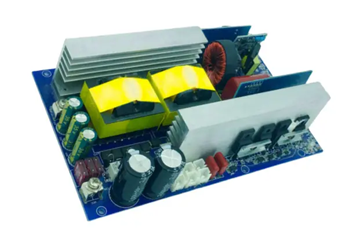
Electricity Metering and Remote Meter Reading in Smart Meter PCB Assembly Smart meter PCBs are engineered to deliver precise electricity consumption tracking and seamless data transmission to utility providers, enabling automated billing and grid management. These circuits integrate high-accuracy measurement components, secure communication modules, and power-efficient microcontrollers to operate reliably in residential, commercial, and industrial settings. Below, we explore the technical implementation of electricity metering and remote data collection in smart meter PCBs.
Current and Voltage Sensing with Shunt Resistors and CTs Smart meter PCBs measure current using either shunt resistors or current transformers (CTs), depending on the application’s current range. Shunt resistors, placed in series with the load, generate a proportional voltage drop that the PCB’s analog front end (AFE) amplifies and converts to digital values via a high-resolution ADC. For high-current systems (e.g., industrial motors), CTs isolate the measurement circuit from the main line, reducing safety risks. The PCB’s microcontroller (MCU) processes these signals alongside voltage readings from potential transformers (PTs) or resistive dividers to calculate real power (kW), reactive power (kVAR), and apparent power (kVA) using formulas like P=V×I×cos(θ), where θ is the phase angle between voltage and current.
Phase Angle Compensation for Reactive Power Calculation Accurate reactive power measurement requires precise phase angle detection between voltage and current waveforms. The PCB employs dedicated hardware (e.g., digital signal processors or DSP cores) or software algorithms to compute the phase difference using zero-crossing detection or discrete Fourier transforms (DFTs). For example, a DFT extracts the fundamental frequency components of voltage and current signals, allowing the MCU to calculate the phase angle and correct reactive power readings. This compensation is critical for utilities billing customers based on power factor, as errors in phase detection could lead to financial discrepancies.
Temperature Compensation and Calibration for Long-Term Stability Environmental factors like temperature fluctuations can drift sensor outputs over time, affecting measurement accuracy. The PCB addresses this by integrating temperature sensors (e.g., thermistors or RTDs) near critical components like shunt resistors or ADCs. The MCU applies temperature coefficients stored in non-volatile memory to adjust readings dynamically. For instance, a shunt resistor’s resistance may increase by 0.1% per degree Celsius, requiring the MCU to scale current measurements accordingly. Manufacturers also calibrate meters during production using precision reference standards, storing calibration constants that the MCU uses to correct raw data. Some designs support field calibration via optical ports or wireless updates to maintain accuracy over decades of use.
2. Secure and Reliable Remote Communication Protocols
Cellular Networks (4G/5G) for Wide-Area Connectivity Smart meter PCBs often use cellular modules to transmit data to utility backends over public mobile networks. 4G LTE provides reliable coverage in urban and rural areas, with data rates sufficient for hourly or daily meter reads. For advanced applications like demand response or outage detection, 5G’s low latency (under 10 ms) enables real-time communication between meters and grid operators. The PCB incorporates a cellular modem with a SIM card interface, handling tasks like network registration, encryption, and error correction. To conserve power, the MCU schedules transmissions during off-peak hours or triggers uploads only when thresholds (e.g., high consumption alerts) are exceeded.
PLC (Power Line Communication) for In-Home Data Transmission In multi-dwelling units or industrial complexes, PLC leverages existing electrical wiring to transmit meter data to a central gateway without additional infrastructure. The PCB modulates digital signals onto the AC power line using technologies like G3-PLC or PRIME, which employ orthogonal frequency-division multiplexing (OFDM) to resist noise from appliances. A coupled transformer isolates the communication circuit from the high-voltage line, while front-end filters reject harmonic interference. The MCU encodes data with forward error correction (FEC) to ensure reliable transmission through noisy environments, enabling gateways to aggregate reads from hundreds of meters and forward them to the cloud via Ethernet or cellular links.
RF Mesh Networks (e.g., Wi-SUN, Zigbee) for Low-Power Local Connectivity For battery-powered meters or areas with limited cellular coverage, RF mesh networks offer a cost-effective alternative. Protocols like Wi-SUN (Wireless Smart Utility Network) or Zigbee form self-organizing networks where meters relay packets to neighbors, extending range without high-power transmitters. The PCB integrates a low-power RF transceiver with a sub-GHz frequency band (e.g., 868 MHz in Europe or 915 MHz in North America) to balance range and penetration through walls. The MCU manages mesh routing, selecting optimal paths based on signal strength and node availability. Security features like AES-128 encryption and device authentication prevent unauthorized access to meter data during transmission.
3. Data Integrity and Tamper Detection Mechanisms
Cryptographic Encryption for Secure Data Transmission To protect consumption data from interception or manipulation, smart meter PCBs encrypt all outbound transmissions using industry-standard algorithms like AES-256 or ECC (Elliptic Curve Cryptography). The MCU generates session keys dynamically for each communication session, rotating them periodically to limit exposure if a key is compromised. Some designs implement mutual authentication, where the meter and utility server verify each other’s identities using digital certificates before exchanging data. For cellular networks, the PCB may use TLS/SSL protocols to secure connections to cloud platforms, ensuring end-to-end encryption from the meter to the billing system.
Physical Tamper Detection with Sensor Arrays Smart meters must detect unauthorized access to prevent theft or data falsification. The PCB incorporates sensors like accelerometers, tilt switches, or magnetic reed switches to monitor physical disturbances. For example, an accelerometer detects vibrations from drilling attempts, while a reed switch triggers an alarm if the meter’s enclosure is opened. The MCU continuously polls these sensors and logs tamper events with timestamps, transmitting alerts to the utility during the next scheduled upload. Some designs include environmental sensors (e.g., light or humidity detectors) to identify covert tampering, such as exposing the meter to moisture to short-circuit components.
Anomaly Detection Algorithms for Consumption Pattern Analysis Beyond physical tampering, the PCB uses onboard analytics to flag suspicious usage patterns indicative of fraud or faults. The MCU compares current readings against historical baselines stored in flash memory, identifying deviations beyond statistical thresholds (e.g., a 50% drop in nighttime consumption). Machine learning models trained on typical load profiles (e.g., residential vs. commercial) can detect more subtle anomalies, such as steady consumption during reported vacations. The MCU tags these events as potential tampering attempts and prioritizes them for immediate transmission to the utility, enabling rapid investigation and resolution.
By combining precision measurement, multi-layered security, and adaptive communication, smart meter PCBs provide utilities with granular visibility into energy usage while empowering consumers to monitor and optimize their consumption. Their modular architecture also supports future upgrades to emerging standards like 6G or quantum-resistant encryption, ensuring longevity in an evolving energy ecosystem.