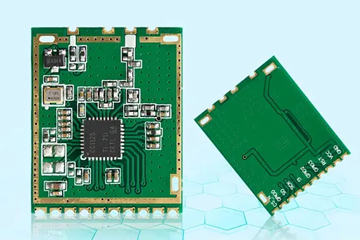
High-Precision Gas Flow Sensing Mechanisms for Accurate Metering
Smart gas meter PCB assemblies integrate advanced flow sensors to measure natural gas or propane consumption with minimal error margins, ensuring utilities and consumers receive precise billing data. These sensors must operate reliably across varying pressures, temperatures, and gas compositions.
Thermal Mass Flow Sensors for Direct Gas Velocity Measurement
Thermal sensors rely on heat transfer principles to detect gas flow rates. A heated resistor (sensor element) is placed in the gas stream, with the PCB monitoring temperature changes caused by convective heat loss. For example, as gas velocity increases, more heat is carried away from the sensor, reducing its temperature. The PCB uses a Wheatstone bridge circuit to measure this resistance change, converting it into a voltage signal proportional to flow rate.
To maintain accuracy, the sensor includes a reference resistor shielded from the gas flow to compensate for ambient temperature fluctuations. The microcontroller applies a PID control loop to stabilize the sensor’s heating power, ensuring consistent performance across a 0–100% flow range. For gases with varying thermal properties (e.g., methane vs. propane), the firmware adjusts calibration coefficients stored in EEPROM, correcting measurements by up to ±3% to account for specific heat capacity differences.
Differential Pressure Sensors for Volumetric Flow Calculation
Differential pressure (DP) sensors measure the pressure drop across an orifice plate or venturi tube installed in the gas pipeline. The PCB converts this pressure difference into flow rate using Bernoulli’s principle, with the microcontroller applying square root extraction algorithms to linearize the output. For instance, a 50 Pa pressure drop in a 50mm-diameter pipe might correspond to a flow rate of 2 m³/h at standard conditions.
The sensor incorporates a piezoresistive MEMS element with a full-scale range of 0–10 kPa and a resolution of 1 Pa, ensuring detection of minute pressure changes even at low flow rates. The PCB includes a temperature compensation circuit to correct for the gas’s thermal expansion, which can alter pressure readings by up to 0.5% per °C. To mitigate condensation in humid environments, the sensor housing features a hydrophobic coating and a built-in heater activated during cold starts.
Real-Time Gas Quality Monitoring for Safety and Efficiency
Beyond volume measurement, smart gas meters analyze gas composition and physical properties to detect leaks, contamination, or unsafe operating conditions, enhancing user safety and system reliability.
Electrochemical Sensors for Combustible Gas Detection
Electrochemical sensors detect hazardous gases like carbon monoxide (CO) or hydrogen sulfide (H₂S) by measuring the current generated during oxidation/reduction reactions at electrode surfaces. The PCB applies a fixed potential (e.g., +0.8V for CO) between the working and counter electrodes, with the resulting current (typically 10–100 nA per ppm) digitized by a 24-bit ADC. For example, a CO concentration of 50 ppm might produce a 5 μA current, triggering an alarm if pre-set thresholds are exceeded.
To extend sensor lifespan (typically 2–3 years), the PCB includes a pulsed voltage scheme that reduces electrode polarization. The microcontroller runs baseline correction algorithms to account for sensor drift over time, subtracting the average zero-point current (measured in clean air) from subsequent readings. Cross-sensitivity to other gases (e.g., methane interfering with CO measurements) is minimized by selecting sensor materials with high selectivity coefficients.
Infrared Spectroscopy for Gas Composition Analysis
Non-dispersive infrared (NDIR) sensors use broadband IR sources and narrowband filters to detect specific gas molecules based on their absorption spectra. The PCB modulates the IR source at 1Hz to differentiate between gas absorption and ambient light interference, with a pyroelectric detector measuring transmitted intensity. For example, methane absorbs IR light at 3.3 μm, so a drop in detected intensity at this wavelength indicates its presence.
The microcontroller applies Beer-Lambert law calculations to convert absorption levels into concentration values, correcting for path length and gas pressure variations. To improve accuracy, the sensor includes a reference channel (e.g., 4.3 μm for CO₂) to normalize measurements against non-absorbed IR. The PCB stores calibration curves for common gas mixtures (e.g., 95% methane, 3% ethane, 2% propane) in flash memory, enabling automatic adjustment based on detected composition.
Secure and Reliable Data Transmission for Remote Monitoring
Smart gas meters transmit consumption and safety data to central servers or user devices using wireless protocols designed for low-power, long-range communication, even in challenging environments like basements or metal enclosures.
Wireless M-Bus for European Utility Networks
The Wireless M-Bus protocol operates in the 169 MHz band, offering robust penetration through walls and concrete with minimal power consumption. The PCB integrates a transceiver with a link budget of 120 dB, enabling communication over 1 km in urban areas and 3 km in rural settings. For example, a meter transmitting 200-byte packets every 15 minutes might configure the transceiver to 50 mW output power, achieving a 2-year battery life on a 2.4 Ah lithium-ion cell.
To ensure data integrity, the protocol uses AES-128 encryption and CMAC authentication for all messages. The microcontroller implements a time-slotted channel hopping (TSCH) mechanism to avoid collisions, synchronizing transmissions with a network master clock. Retransmission policies automatically resend failed packets up to five times, with exponential backoff delays to prevent network congestion.
Sub-GHz RF for North American Deployments
Sub-GHz frequencies (e.g., 915 MHz in the U.S.) provide a balance between range and data rate, making them suitable for gas meters installed in residential or commercial buildings. The PCB includes a frequency-hopping spread spectrum (FHSS) transceiver that dynamically switches between 50 channels to mitigate interference from Wi-Fi or Bluetooth devices. For instance, a meter transmitting 150-byte packets hourly might use 10 mW output power, achieving a 500-meter range while consuming 20 μAh per transmission.
Data is formatted using a proprietary protocol optimized for low-bandwidth applications, with headers containing meter ID, timestamp, and checksum fields. The firmware implements forward error correction (FEC) to recover up to 10% of corrupted bits, reducing the need for retransmissions. To comply with FCC regulations, the transceiver limits duty cycles to 1% and includes spectral masking filters to suppress out-of-band emissions.
Edge Computing for Local Anomaly Detection
Onboard processing capabilities enable gas meters to analyze flow and safety data in real time, identifying leaks or abnormal usage patterns before uploading alerts to the cloud. This reduces data transmission volumes and ensures immediate action during network outages.
The microcontroller runs a rule engine that evaluates flow rates against historical baselines (e.g., average daily consumption) and time-based thresholds (e.g., zero flow during nighttime hours). For example, continuous flow above 0.1 m³/h for 4 hours might trigger a “potential leak” alert, while a sudden spike to 10 m³/h could indicate a ruptured pipe. The firmware stores anomaly logs in a circular buffer with timestamps, ensuring no events are lost during temporary connectivity issues.
To detect tampering, the PCB incorporates accelerometers and magnetic sensors that monitor for unauthorized movement or strong external fields. If tampering is detected, the meter encrypts and transmits an alert immediately, then switches to a secure mode that limits functionality to basic flow measurement until maintenance is performed.


