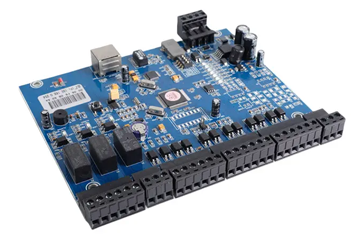
Core Architecture of Flight Control PCB Assembly for UAVs
The flight control system of unmanned aerial vehicles (UAVs) serves as the "brain" that coordinates sensor data, power management, and motor control. A well-designed PCB assembly integrates multiple functional modules while addressing electromagnetic interference (EMI), thermal management, and mechanical robustness. The core architecture consists of four interdependent layers: sensor fusion, power distribution, motor drive, and communication interfaces.
Sensor Fusion Module Implementation
Modern UAVs rely on a 9-axis inertial measurement unit (IMU) combining triaxial accelerometers, gyroscopes, and magnetometers. These sensors must be mounted directly on the PCB with minimal mechanical isolation to ensure real-time data transmission. For example, accelerometers measure linear acceleration while gyroscopes track angular velocity, enabling the flight controller to calculate roll, pitch, and yaw angles through complementary filtering algorithms. A typical implementation uses operational amplifiers configured for differential amplification and low-pass filtering, with cutoff frequencies optimized based on the vehicle's expected motion range. In high-precision applications, a Kalman filter combines accelerometer and gyroscope data to mitigate drift, achieving sub-degree attitude estimation accuracy.
PCB layout for sensor modules requires careful consideration of trace routing and grounding. Differential signaling pairs for I2C or SPI communication must maintain equal trace lengths with controlled impedance to prevent data corruption. Decoupling capacitors placed within 0.1 inches of sensor power pins minimize voltage fluctuations during rapid maneuvers. For instance, a 0.1μF ceramic capacitor combined with a 10μF electrolytic capacitor can suppress both high-frequency noise and low-frequency ripple.
Power Management and Redundancy Design
UAV flight control systems demand multi-stage voltage regulation to isolate sensitive analog components from noisy digital sections and high-current motor loads. The primary power path typically involves a DC-DC converter stepping down battery voltage (24-48V) to 12V for auxiliary systems, followed by low-dropout (LDO) regulators producing 5V and 3.3V for digital and analog circuits respectively. Critical designs incorporate redundancy through P-channel MOSFET-based automatic switching circuits. When the main power supply drops below a threshold (e.g., 4.5V), a backup battery or BEC (Battery Eliminator Circuit) seamlessly takes over, ensuring continuous operation during primary power failures.
Thermal management plays a crucial role in power module reliability. High-current traces require thick copper layers (2oz or more) and multiple vias to reduce resistance and heat buildup. For example, a 20A motor driver circuit might use 4oz copper traces with thermal vias connecting to a ground plane, dissipating heat through conductive pathways. Additionally, TVS (Transient Voltage Suppressor) diodes protect against voltage spikes caused by motor inductance, while ferrite beads suppress high-frequency noise on power lines.
Motor Drive Circuitry and Control Algorithms
The motor drive module converts digital control signals into precise PWM outputs for brushless DC motors. Modern designs use half-bridge or full-bridge driver ICs capable of handling peak currents exceeding 20A, with isolated gate drivers preventing ground loops. For instance, a three-phase inverter circuit might employ six N-channel MOSFETs arranged in a full-bridge configuration, driven by PWM signals generated by a microcontroller's advanced timer peripherals. The control loop executes at frequencies above 200Hz to maintain stability during rapid maneuvers, with dead-time insertion preventing shoot-through faults that could damage the MOSFETs.
Control algorithms form the backbone of motor drive performance. A cascaded PID (Proportional-Integral-Derivative) architecture is commonly used, where the outer loop regulates vehicle tilt angle while the inner loop controls motor torque. For example, the angle PID might have a proportional gain of 0.5, integral gain of 0.01, and derivative gain of 0.1, tuned through Ziegler-Nichols methods to achieve a settling time under 0.5 seconds with minimal overshoot. Advanced implementations incorporate feedforward compensation to anticipate disturbances, such as wind gusts, improving dynamic response.
Communication Interfaces and EMI Mitigation
Wireless communication modules enable real-time telemetry and remote control, with common protocols including 2.4GHz radio, Wi-Fi, and Bluetooth. These modules must be shielded from motor-induced EMI through careful PCB layout. For instance, the antenna trace should be kept at least 0.2 inches away from high-current traces and power planes, with a ground stitching via every 0.5 inches to provide a low-impedance return path. Shielding cans made of conductive material can further reduce radiated emissions, particularly around sensitive RF circuits.
Signal integrity optimization involves impedance-controlled routing for high-speed differential pairs, such as USB or CAN bus interfaces. A 90-ohm differential impedance might be targeted for USB 3.0 signals, achieved through precise trace width and spacing calculations. Additionally, EMI filters composed of ferrite beads and capacitors are placed at module interfaces to suppress common-mode noise. For example, a 100nF capacitor combined with a 100Ω ferrite bead can attenuate noise in the 100MHz-1GHz range, ensuring compliance with FCC Part 15 regulations.