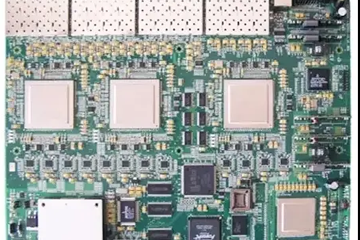
In batch PCB manufacturing, to enhance production efficiency, efforts should be made from five aspects: layout design optimization, application of automated equipment, supply chain collaboration, process innovation, and intelligent management. The following are specific strategies and analyses:
First, optimization of the layout design
Improve the utilization rate of materials
Standard board compatibility: Select standard board sizes such as 18"×24" (457mm×610mm) or 21"×24" (533mm×610mm) to reduce edge waste. For instance, a 50mm×50mm PCB can be arranged into a 6×8 matrix to form a 300mm×400mm layout, with the utilization rate approaching maximum.
Shared Edge design: For PCBS with similar contours, Common Edge is adopted for assembly to reduce cutting loss. For example, two rectangular PCBS share a V-Cut line, which can reduce material waste.
Optimize the efficiency of SMT assembly
Layout of process edges and Mark points: Add a 5mm to 10mm process edge around the panel to facilitate transmission and clamping. The Mark points are clearly laid out to improve the recognition accuracy of the surface mount technology (SMT) machine.
Alignment and bridging design in the same direction: Ensure that all PCB components are in the same direction and reduce the rotation Angle of the surface mount machine. The Tab-routing (milled edge panel with bridge connection) is adopted to reduce the stress of panel separation and improve the SMT efficiency.
Second, the application of automated equipment
Intelligent panel assembly and production scheduling system
The intelligent panel assembly system was introduced, increasing the material utilization rate by more than 12%. Dynamic scheduling is achieved through the MES system, increasing equipment utilization by 25%.
Automated testing and inspection
Parallel testing equipment is adopted to achieve simultaneous testing of 10 to 20 circuit boards, and the testing efficiency is improved several times. Combined with AOI detection technology, reduce the error of manual detection.
Third, supply chain collaborative optimization
Component centralized procurement and alternative solutions
Enter into strategic cooperation with global substrate manufacturers to reduce procurement costs by 15%. Prepare a list of component substitutes during the design stage to ensure the stability of supply.
Contract manufacturing and material supply services
Outsource the procurement of components to PCBA processors and take advantage of their long-term cooperative relationships to obtain better prices and delivery times, thereby reducing the time cost of procurement.
Fourth, technological innovation and standardization
Direct Imaging Technology (LDI
The adoption of LDI technology reduces dry film loss by 30%, enhancing process accuracy and efficiency.
Standardized component library management
Conduct process feasibility verification in advance, adopt a standardized component library, and reduce the process adjustment time during production.
Fifth, intelligent management and process optimization
Digital management and feedback mechanism
Utilize systems such as MES to achieve digital management and enhance decision-making efficiency; Establish a feedback mechanism and continuously optimize the production process.
Rapid testing and verification
Conduct rapid testing and verification for small-batch trial production to shorten the product launch cycle; Product quality is ensured through means such as X-ray inspection and ICT testing.