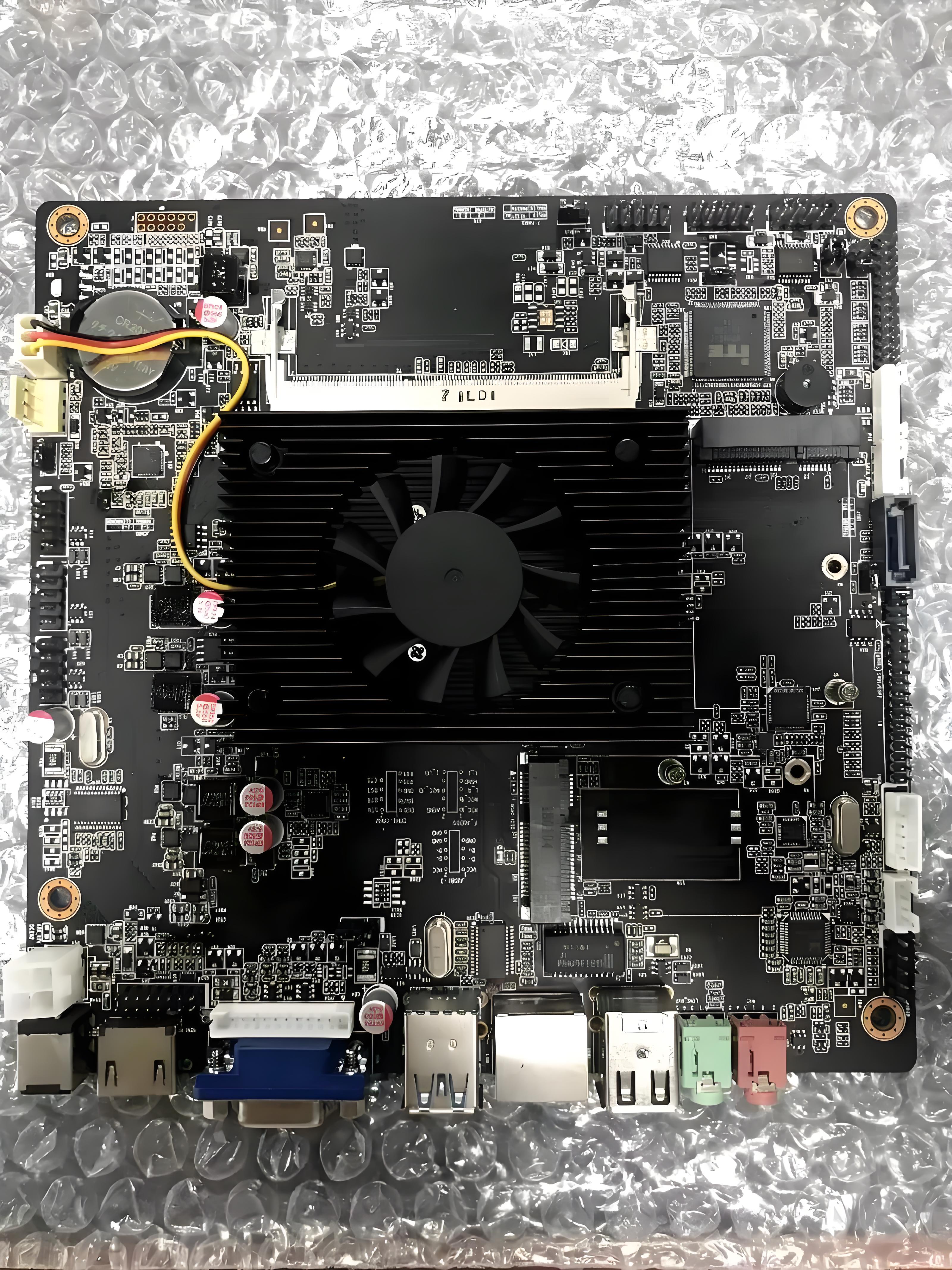
Brown Oxide Treatment is a key process in the manufacturing of PCB multi-layer boards. Through chemical oxidation, a nano-scale rough copper oxide (CuO or Cu₂O) film is formed on the surface of the copper foil, significantly enhancing the mechanical bonding force, chemical bond force and interfacial wettability between the copper layer and the resin substrate. Thereby preventing interlayer delamination, improving thermal stability and extending the lifespan of the PCB. The following is an analysis from the aspects of principle, application and optimization:
First, the principle of Browning treatment
Surface roughening
The oxide layer on the surface of the copper foil is removed by chemical etching (such as persulfate or perchloric acid solution) to form a microscopic rough structure (Ra 0.3-1.2μm), increasing the mechanical intercalation force between the resin and the copper layer.
The rough surface makes the resin more permeable during the lamination process, and after curing, it forms an "anchoring effect", significantly enhancing the interlayer bonding strength.
The copper oxide layer is formed
Under acidic conditions, copper foil is oxidized with sodium chlorite (NaClO₂) or hydrogen peroxide (H₂O₂) to form CuO (black) or Cu₂O (red) oxide layers.
The chemical bonding force between Cu₂O and resin is stronger, but it is prone to moisture absorption. The oxide layer needs to be protected through post-treatment (such as silane coupling agent) to prevent the increase of interfacial brittleness after lamination.
The interface can be optimized
Browning treatment reduces the surface energy of copper, enhances the wettability of the resin, reduces interface defects (such as bubbles and voids), and ensures that the resin is evenly spread and penetrates into the fine areas of the copper layer.
Second, the application of Browning treatment
Enhance the interlayer bonding force
In the manufacturing of multi-layer PCBS, the bonding strength between the copper foil and the Prepreg sheet after Browning treatment is enhanced by 30% to 50%, effectively preventing delamination, bubbling or board breakage after lamination.
Typical case: High-frequency PCBS (such as 5G communication boards) undergo Browning treatment, with a bonding force of more than 1.5N /mm, meeting the IPC-TM-650 standard.
Prevent the oxidation and corrosion of the copper layer
The Browning film serves as a physical barrier to prevent the copper layer from coming into contact with oxygen and moisture, thereby delaying the oxidation rate in high-temperature environments.
Experimental data: The corrosion rate of the copper layer after Browning treatment decreased by 60% after 1000 hours in an environment of 85°C/85%RH.
Improve welding and thermal stability
The surface roughness of the copper after Browning treatment is uniform, reducing welding defects (such as false soldering and cold soldering), and increasing the welding yield by 10% to 15%.
The thermal stability of the Browning film enables the copper layer to maintain its performance during the 260°C reflow soldering process, reducing deformation or peeling caused by thermal stress.
Optimize the performance of high-frequency signals
Traditional brownization may increase high-frequency signal loss due to excessive surface roughness (Ra 1.5-2.0μm) (for example, insertion loss increases by 0.3-0.5 dB/inch at 10GHz).
Improvement plan: Adopt a low-roughness Browning process (such as organic coupling agents or nano-coatings) to reduce Ra to 0.3-0.7μm, significantly lowering high-frequency losses.
Third, the optimization direction of Browning treatment
Process parameter control
The thickness of the oxide layer is preferably 50 to 200nm. If it is too thin, the bonding force will be insufficient; if it is too thick, it is prone to cracking.
Lamination parameters: temperature, pressure and time need to match the resin system (for example, halogen-free resin requires a rougher brownization layer).
Alternative oxidation technology
Alternative Oxide: Utilizing organic coupling agents or nano-metal coatings to reduce surface roughness while maintaining adhesion, it is suitable for high-frequency PCBS.
Double-layer Browning technology: First, a light Browning is carried out to form Cu₂O, followed by a secondary oxidation to form CuO, which takes into account both binding force and moisture resistance.
Intelligent monitoring and detection
The composition of the oxide layer was analyzed by X-ray photoelectron spectroscopy (XPS) to ensure the quality of Browning.
The microstructure of the copper foil surface was observed by scanning electron microscopy (SEM), and the roughness parameters were optimized.
Fourth, Conclusion
Browning treatment significantly enhances the interlayer bonding force, corrosion resistance and thermal stability of PCBS through surface roughening, formation of copper oxide layers and optimization of interface energy. It is a key process to ensure the quality of multi-layer boards. With the growth in demand for high-frequency PCBS, low-roughness Browning technology and intelligent monitoring methods will become the future development direction, helping the PCB industry move towards high density and high reliability.


